
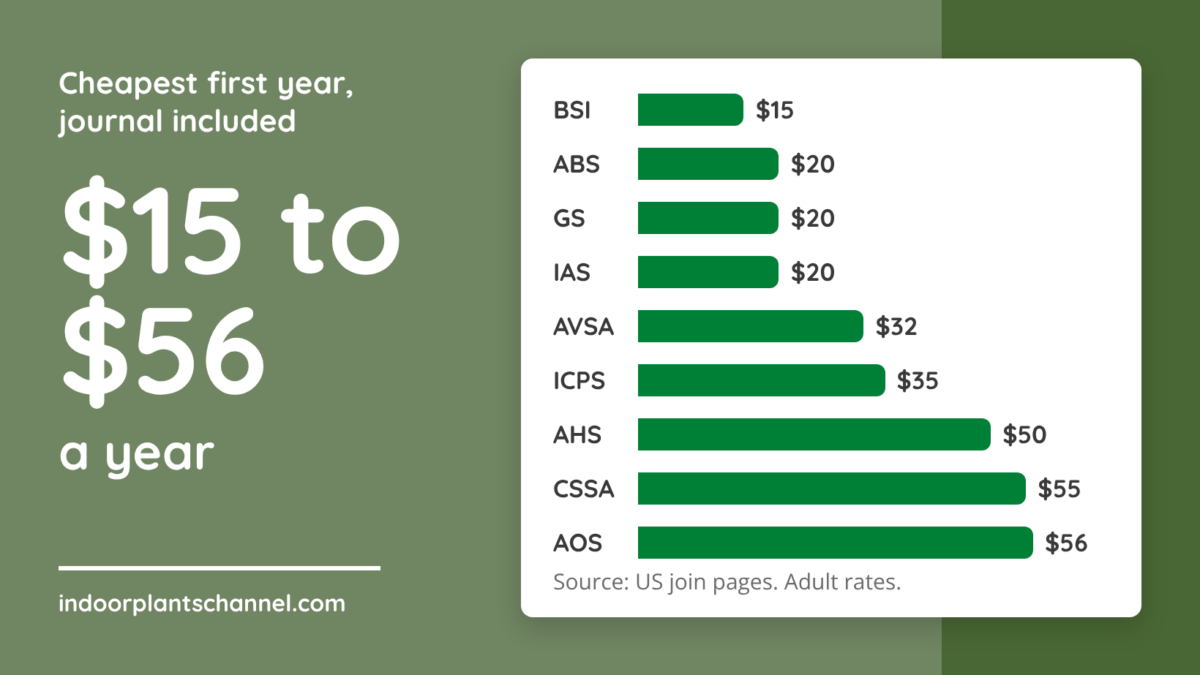

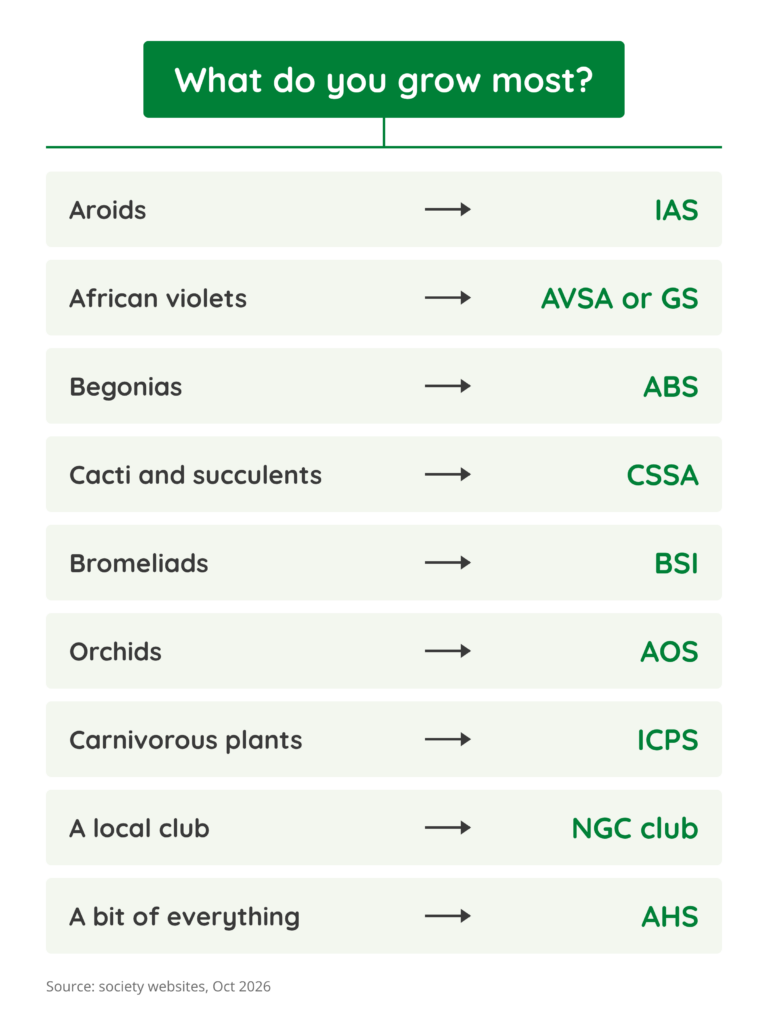
Join the society for the plants you grow most. The eight specialist societies below charge between $15 (Bromeliad Society International) and $56 (American Orchid Society) for a first year with the journal. For gardening in general, the American Horticultural Society costs $50. For cuttings and people near you, find a local club. Every price below was read on the society’s own site on 8 October 2026.
Extension Master Gardener is a different animal. It is a university training course with a volunteer commitment, and you pay a course fee rather than dues.
What a plant society does that a Facebook group can’t
A free group is fine for a quick photo of a yellow leaf. Once you start collecting a genus, you run into things a group can’t give you.
1. The name on the label is official
Cultivar names are registered, and societies keep the registers. The American Begonia Society calls itself “the authorized organization for registration of cultivars”. AVSA handles international registration for the genus Saintpaulia. The International Aroid Society is the official registrar for the Araceae family. Bromeliad Society International lets anyone search its cultivar registry, member or not. If a seller’s tag doesn’t match the register, ask the seller before you pay rare-plant money.
2. Seed you won’t find at a garden center
The ABS Seed Fund offers seed of Begonia species and hybrids from around the world, and it is open to members only. The Gesneriad Society describes its Seed Fund as “the largest source of gesneriad seed available in the world”. BSI has a Seed Bank. ICPS runs a member-only seed exchange, and CSSA members can buy from the Seed Depot when it has stock.
3. Decades of back issues
AHS members can read American Gardener archives dating back to 1922. ICPS members get PDFs of every Carnivorous Plant Newsletter since 1972. Gesneriad Society back issues come as searchable PDFs, and every AOS member can open the digital archive of Orchids, a magazine in print since 1932. Search the archive for your genus before you post the question anywhere.
4. A named expert who answers you
ABS members have a Horticultural Correspondent for growing questions. IAS members can join Aroid Hour, live members-only calls with aroid experts where you ask your question directly. For bromeliads, BSI lists the Mulford B. Foster Bromeliad Identification Center at Marie Selby Botanical Gardens in Sarasota, Florida, among its membership benefits; it will identify an unknown plant for $5.
5. Shows and judging
If you ever want to show a plant, or judge one, the paths run through societies. The Gesneriad Society runs judging schools where members become certified gesneriad judges. National Garden Clubs has school programs that lead to Flower Show Judge status.
The directory: 10 plant societies, dues and benefits
US rates for one year, copied from each society’s own membership page on 8 October 2026. Where a society sells digital and print separately, both are shown. Anything I couldn’t find on the society’s own site is left out.
| Society | Best for | What members get | Dues as published (US, 1 year) | How to join |
|---|---|---|---|---|
| American Horticultural Society (AHS) | General gardeners who visit public gardens | American Gardener 6 times a year, archive to 1922, free or reduced entry at 400 gardens | $50; Senior (65+) $35; Dual/Family $70 | Online or 703.768.5700 ext. 119 |
| National Garden Clubs (NGC) | People who want a local club | The National Gardener, state and regional newsletters, judge schools | Set by your local club; no national individual rate published. | Club locator |
| International Aroid Society (IAS) | Aroid collectors | Aroideana, Araceae Today, 8 care guides, Discord, Aroid Hour | $20 | aroid.org/join |
| African Violet Society of America (AVSA) | African violet growers | African Violet Magazine 6 issues, store discounts, Violet Preservation page | $32 digital; $40 print + digital | Membership page |
| American Begonia Society (ABS) | Begonia growers; one membership covers 2 people in a household | The Begonian every 2 months, archive, Seed Fund, Horticultural Correspondent | $20 digital; $35 print + digital (covers 2 people) | Online or mail-in form |
| The Gesneriad Society (GS) | Violets and the rest of the gesneriad family | Gesneriads 4 times a year, searchable back issues, Seed Fund, judging schools | $20 Green Delivery (PDF); $25 print | Application page |
| Cactus and Succulent Society of America (CSSA) | Cactus and succulent growers | Cactus and Succulent Journal (4 issues), To the Point, Seed Depot | $55 Standard; $20 Supporter (no journal) | Membership page |
| Bromeliad Society International (BSI) | Bromeliad growers | Quarterly journal and archive, 40,000+ species photos, Seed Bank | $15 electronic, first year ($25 renewal); $45 print, first year | Join page |
| American Orchid Society (AOS) | Orchid growers | Orchids magazine, digital archive, OrchidPro, monthly webinar | $56 Silver (online); $88 Gold (print) | Online or (305) 740-2010 |
| International Carnivorous Plant Society (ICPS) | Carnivorous plant growers | Carnivorous Plant Newsletter quarterly, PDFs since 1972, Seed Bank | $35 e-membership; $45 print (same price anywhere) | icps.clubexpress.com |
American Horticultural Society (AHS)
The broadest membership on this list, built around gardens more than any one plant. You get American Gardener six times a year, archives back to 1922, discounts on AHS LIVE programs and online courses, and free or reduced admission at 400 public gardens and arboreta in North America. Individual dues are $50. AHS values the magazine at $20 and says the remaining portion of your dues may be tax deductible. Join online or call the membership department at 703.768.5700 ext. 119.
National Garden Clubs (NGC)
You don’t join NGC as an individual: you find a local club through the club locator, pay what that club charges, and get The National Gardener plus regional and state newsletters.
International Aroid Society (IAS)
Seventeen aroid growers met at a home in Miami on June 18, 1977 and started the American Aroid Society. Within a year it had 362 members in 15 countries. Today $20 a year buys the peer-reviewed journal Aroideana, the Araceae Today newsletter, eight care guides (variegation and hybridizing Anthurium among them), the members-only Discord and Aroid Hour. Join at aroid.org/join.
African Violet Society of America (AVSA)
Digital membership is $32; add $8 and the six color issues a year of African Violet Magazine come in print too. Members also get the Violet Preservation page, where you can track down older hybrids. The society has run since November 8, 1946, organized in Atlanta and now with an office in Beaumont, Texas.
American Begonia Society (ABS)
Every ABS membership is a family membership covering two people in the same household, so $20 digital or $35 print covers you and whoever shares your windowsills. You get The Begonian every two months, the archive and recorded Zoom talks. The society began on a January evening in 1932 in Long Beach, California, as the California Begonia Society.
The Gesneriad Society (GS)
The family this society covers has over 3,400 species, and the African violet is only the best-known of them. US dues are $25 a year, or $20 for Green Delivery, which sends the quarterly journal Gesneriads as a PDF. Not ready to pay? The monthly e-zine Gleanings is free to non-members. Founded in 1951 as The American Gloxinia Society, it now has over 1,000 members and chapters in the USA, Canada and Sweden.
Cactus and Succulent Society of America (CSSA)
The Cactus and Succulent Journal has been published since 1929. Standard membership is $55 a year in the US and brings four issues of it. The $20 Supporter tier drops the journal but keeps the To the Point newsletter and the Seed Depot. A warning: cssainc.org is the society’s lapsed former address, now run by a site that says on its own front page that it is not affiliated with CSSA, so don’t join or pay there. The society lives at cactusandsucculentsociety.org.
Bromeliad Society International (BSI)
The cheapest first year here. BSI’s rates sheet (effective November 1, 2022) lists $15 for a first-time electronic membership and $25 at renewal; the printed journal in the US is $45 the first year and $55 after. If you saw a $7.50 offer, that was the 75th-anniversary price, and it ended on July 31, 2026.
American Orchid Society (AOS)
Over 100,000 photos of award-winning orchids sit in OrchidPro, open to every member. Silver membership is $56 a year with Orchids online; Gold, at $88, adds the printed magazine every month. The society dates from 1921 and has close to 10,000 members worldwide. Join online or call (305) 740-2010.
International Carnivorous Plant Society (ICPS)
Print membership is US$45 a year no matter where you live, or US$35 for an e-membership without the printed Carnivorous Plant Newsletter. Multiyear terms take $5 a year off either. Membership runs on a separate ClubExpress site. Join or renew at icps.clubexpress.com.
National society or local club?
The national society is where the journal, the archive and the seed fund live. A local group is where cuttings change hands, and you can’t mail-order that.
An ABS branch is a group of at least seven members. Meetings are usually monthly, with speakers and sales and, in the society’s own words, “especially, plant cuttings and plant swaps”. The meetings are open to the public, so you can visit before you join. Even so, over half of ABS members belong to no branch at all. Joining the national society on its own is normal.
NGC runs the other way round, since the local club is the membership. If you grow gesneriads in the USA, Canada or Sweden, look for a Gesneriad Society chapter too.
Where Extension Master Gardener fits
Master Gardener is a volunteer training program, and nearly all of them run through a state land-grant university and its Cooperative Extension Service. It started in Washington state in 1973 and now runs in 49 states and DC, with more than 76,500 volunteers who serve the public through helplines and plant clinics. You pay a training fee instead of dues, and you owe volunteer hours.
- University of Minnesota: an online core course of about 60 hours for $340, then 50 volunteer hours in your first year and 25 a year after, plus 5 hours of continuing education.
- Penn State, York County: 45 hours of classes for $275, 50 volunteer hours in year one and at least 20 a year after. You apply in the county where you live.
To find your own state’s program, AHS keeps a region-by-region list of Master Gardener programs.
Getting your money’s worth as a member
Time your join to the journal
CSSA publishes its cut-offs: join or renew by January 31, April 30, July 31 or October 31 for issues 1 to 4. If a cut-off is a week or two away, join before it rather than after. AVSA posts each digital magazine on the first day of January, March, May, July, September and November. ICPS generates its mailing list about seven weeks before each issue date, so a print member who joins within seven weeks of an issue date may not be on that issue’s mailing list.
Allow for activation, too. The Gesneriad Society says an online membership can take up to five business days to switch on, and up to 15 business days by mail. An ABS membership starts the day ABS receives it.
Mine the archive
Pull every back-issue article on the genus you grow while you’re still keen. Gesneriad Society, ICPS, AHS and BSI members all get an archive. Favor articles by growers in your climate or under lights like yours.
Order seed, ask one question
Order from the seed fund. Then take one specific problem to the ABS Horticultural Correspondent or an IAS Aroid Hour call. Give the plant’s full name, your light, your mix and what changed before the trouble started.
Go to a meeting
Visit an ABS branch meeting or a Gesneriad Society chapter, or plan for the AVSA National Convention and Show. Bring a rooted cutting if the group swaps.
Pick your renewal term
- Gesneriad Society, US individual: 3 years for $70 against $75 for three single years.
- BSI, printed journal in the US: 3-year renewal $155 against $165 for three single renewals.
- ICPS: multiyear terms are $5 a year cheaper on both print and e-membership.
- AOS: a 2-year term costs exactly double, but two-year members get vouchers for $30 off vendor orders of $100 or more.
FAQ
Are plant society dues tax deductible?
It depends on the society, so read its join page. AHS says its magazine is worth $20 and the remaining portion of dues may be tax deductible. ICPS says the opposite: its dues pay for member benefits, so they are not tax deductible.
Is a life membership worth it?
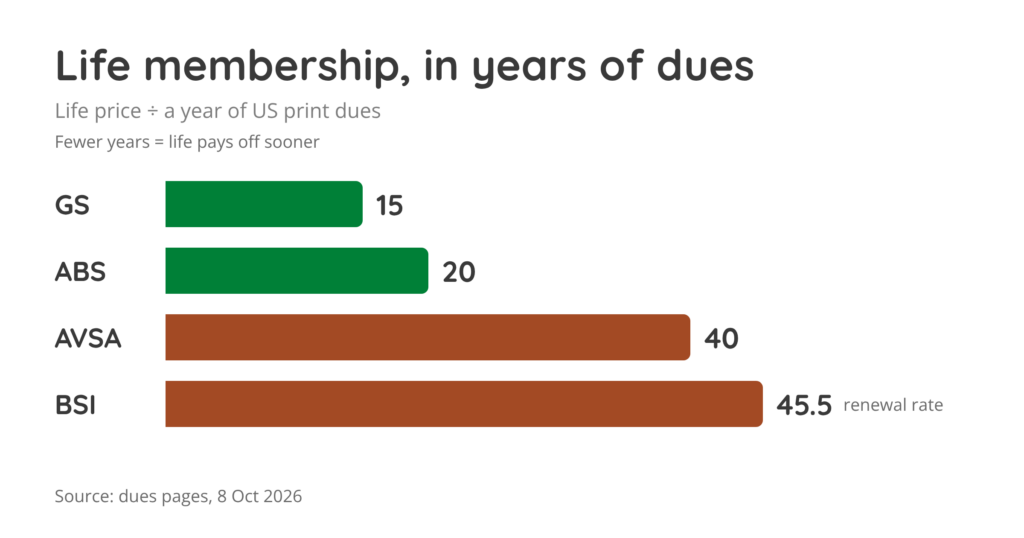
Divide the life price by the yearly print dues. At the Gesneriad Society, $375 equals 15 years at $25. At ABS, $700 equals 20 years at $35. At AVSA, $1,600 is 40 years at $40, and BSI’s $2,500 is 45.5 years of $55 renewals. Fifteen years is a fair bet if you’re sure about the genus. Forty-five is a gift to the society.
Should I pick digital or print?
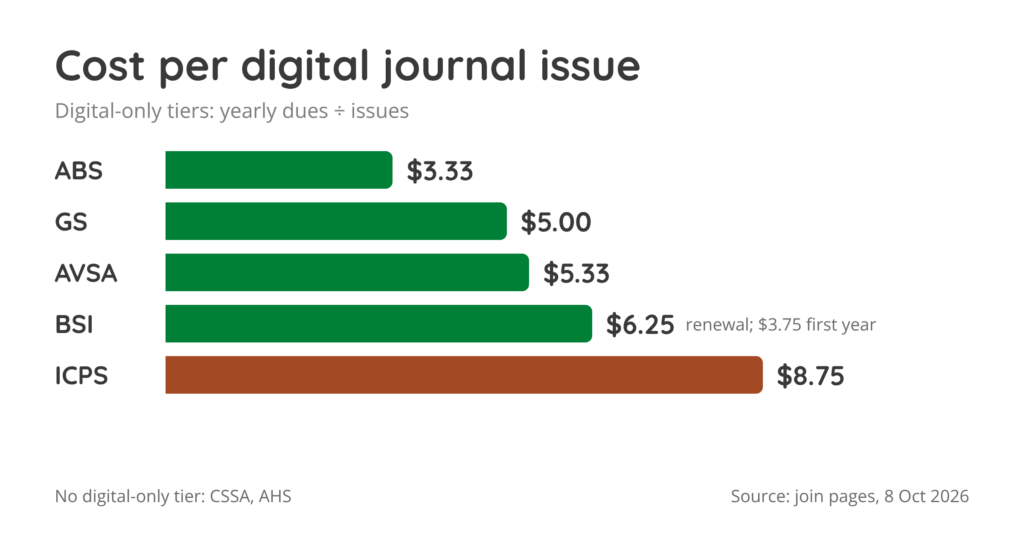
Where a society sells both, digital is the cheaper tier, and the cost per issue varies widely between societies. ABS digital works out to $3.33 an issue (six issues for $20), while ICPS e-membership is $8.75 an issue (four for $35). Pick print if you keep a reference shelf. Pick digital if you search more than you browse.
I grow African violets. AVSA or the Gesneriad Society?
Both cover them. The African violet (Saintpaulia) is the best-known member of the gesneriad family. AVSA is the registration body for Saintpaulia, and its magazine is about growing African violets. The Gesneriad Society covers the whole family of over 3,400 species. If violets are all you grow, start with AVSA. If your shelf has drifted into their relatives, the Gesneriad Society is the better fit.
How big is National Garden Clubs?
About 145,000 members in nearly 5,000 local clubs, by NGC’s own count. Other NGC pages give figures between 130,000 and 165,000, so treat any single number as approximate.
Can I try a society before I join?
Yes, in several places. The Gesneriad Society’s Gleanings e-zine is free. ABS branch meetings are open to the public. BSI’s cultivar registry is open to anyone.
Plant Societies Worth Joining: Dues, Benefits and How to Join (2026 Directory)


Michelle Wilde is a stay-at-home mom and avid plant lover. Armed with a post-graduate degree in Computer Science (no kidding!), she loves researching plants and landscapes. When she is not caring for her 4 kids, she spends time on her passion for plants. She blogs at www.indoorplantschannel.com, the trusted source for indoor plants.
Learn more