

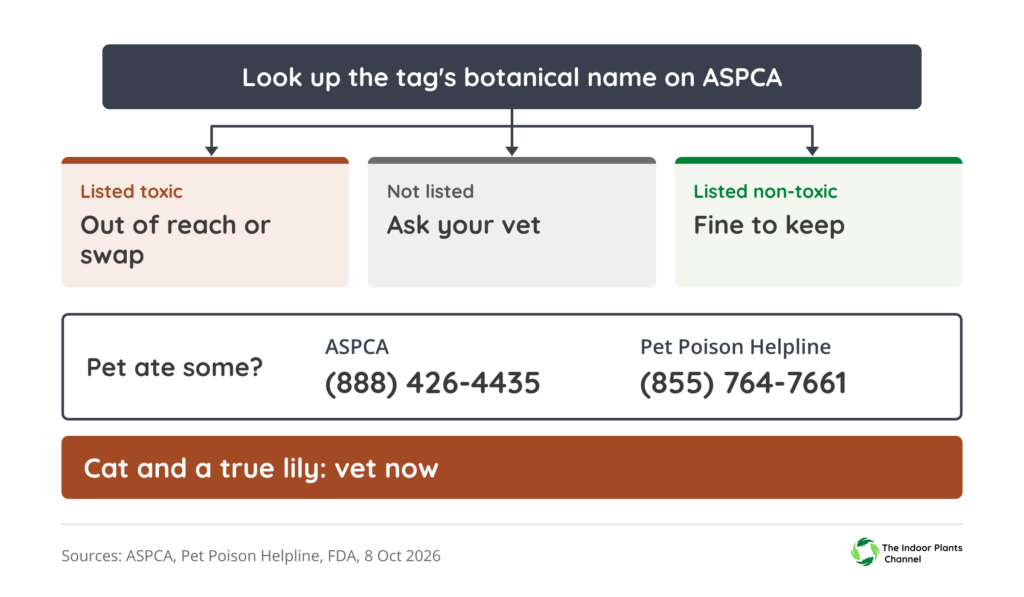
Find the botanical name on the plant’s tag and look it up in the ASPCA Toxic and Non-Toxic Plants list. Don’t trust the common name, and don’t match by photo. If the plant isn’t on the list, that means unknown, not safe. If your pet already ate some, call your vet or a pet poison line now.
Updated 8 October 2026. The 2022 version of this page called 13 plants safe for pets. Only 3 of them are. This version corrects that. Every status below links to the ASPCA entry it came from, read on 8 October 2026.
- ASPCA Animal Poison Control: (888) 426-4435, 24 hours a day, 365 days a year. A consultation fee may apply.
- Pet Poison Helpline: (855) 764-7661, 24/7, $89 per incident, follow-up calls included.
- A cat that got into a true lily (Lilium) or a daylily (Hemerocallis) goes to the vet now, before any symptoms. Pollen and vase water count.
- Any plant can make a pet vomit. ASPCA says plants listed as non-toxic, or as mild stomach upset, “are not expected to be life-threatening.”
What we got wrong in 2022
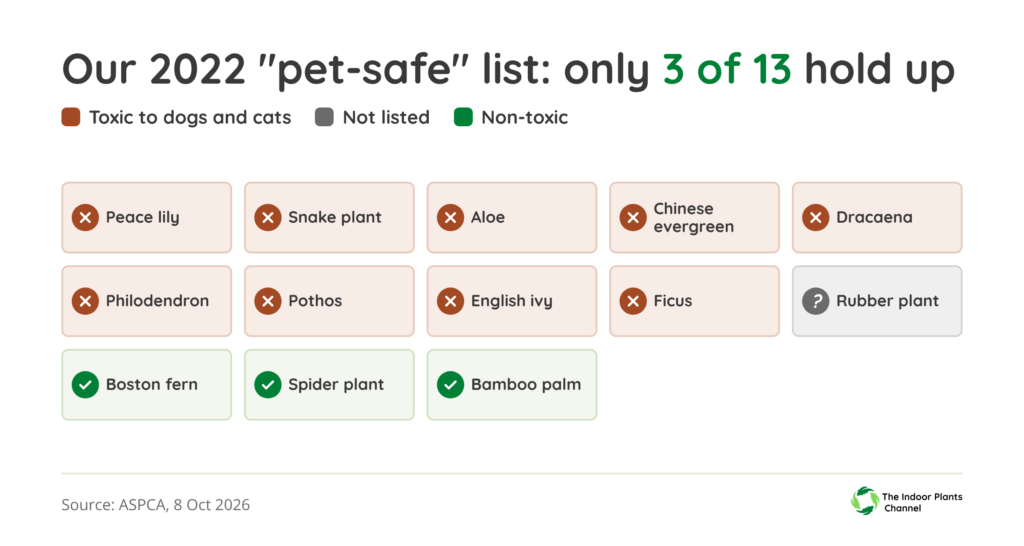
The old version of this page was titled “27 Indoor Plants That Are Safe For Pets And Improve Your Health.” It listed 13. Nine of those 13 are toxic to both dogs and cats on the ASPCA list: peace lily, snake plant, aloe, Chinese evergreen, dracaena, philodendron, pothos, English ivy and ficus. The tenth, rubber plant, is a name trap. ASPCA’s “Indian Rubber Plant” entry is Ficus benjamina, the weeping fig, and it’s toxic. The rubber plant most shops sell, Ficus elastica, isn’t on the list at all, which means unknown, not safe. Only the Boston fern, the spider plant and the bamboo palm hold up.
If you put a pothos in the cat’s room because we said so, move it somewhere the cat can’t get to, like a room it never goes in. We’re sorry.
How does a list go that wrong? Lists copy each other, and common names drift between species. Our 2022 page even got its own photos wrong. The “spider plant” photo was a spider flower (Cleome), and the “bamboo palm” photo was a bamboo forest. Both happen to be non-toxic on ASPCA’s list. That was luck.
The old page also called the ASPCA list a “study” (it’s a database) and said these plants remove carbon monoxide and “boost your immune system.” That’s gone too.
The air-cleaning idea goes back to a 1989 NASA study. It tested benzene, trichloroethylene and formaldehyde, not carbon monoxide, with plants picked jointly with the Associated Landscape Contractors of America. A 2019 review of 12 chamber studies then found you’d need 10 to 1,000 plants per square meter of floor to match ordinary building ventilation. The plants on this page are worth growing, just not as air purifiers.
Common names lie: the “lily” problem
On 8 October 2026 we read every entry on the ASPCA plant list: 1,023 entries covering 591 distinct botanical names. 428 are toxic to dogs or cats, 559 are non-toxic to both, and 36 carry no dog or cat tag (34 of those are horse-only plants). The entries are filed by common name, and that’s where people get hurt. ASPCA says so itself: plants “can have many common names, sometimes even over lapping with other plants.”
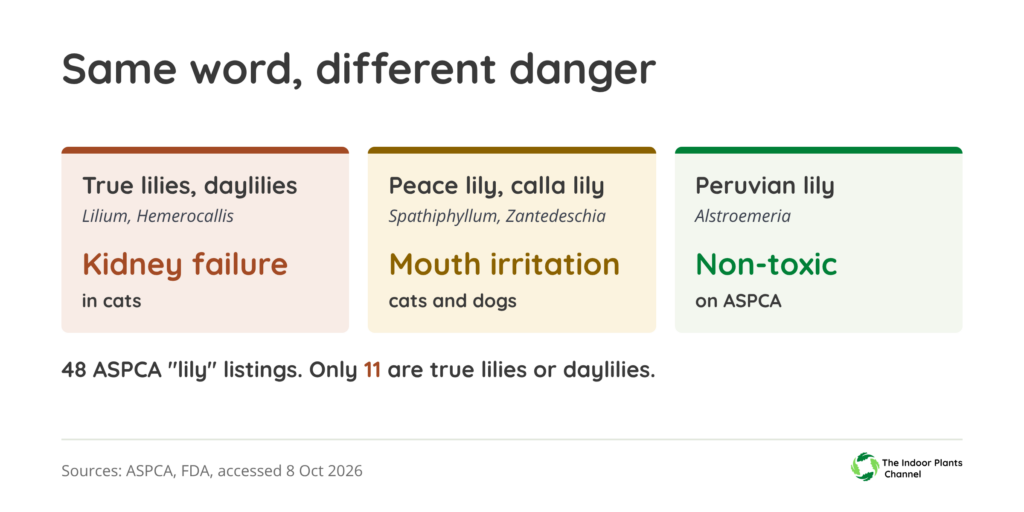
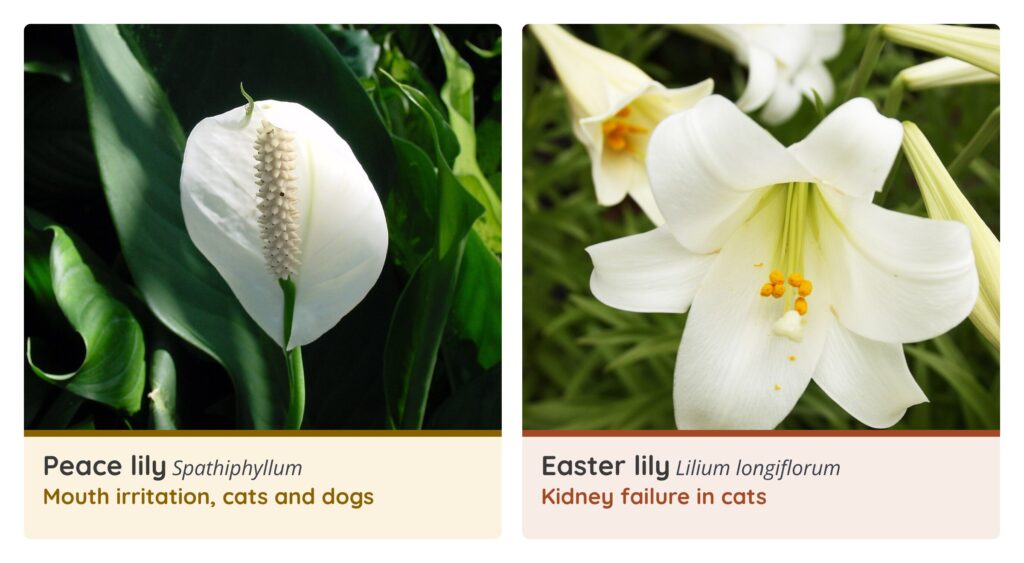
The word “lily” does the most damage. 48 entries have “lily” in the name, and 32 of them are toxic to cats. Only 11 are true lilies (Lilium) or daylilies (Hemerocallis), the group the FDA says can cause fatal kidney failure in a cat in less than 3 days. The stem, leaves, flowers, pollen and even the vase water are all toxic.
Only 10 entries on the whole list are toxic to cats but safe for dogs, and every one of them is a true lily or daylily. (The single reverse case is black walnut.) So any lily answer has to start by asking whether you have a cat or a dog.
| Name on the tag | Botanical name | Cats | Dogs | What it does |
|---|---|---|---|---|
| Easter lily | Lilium longiflorum | Toxic | Non-toxic (ASPCA entry) | Kidney failure in cats |
| Daylily, stargazer, tiger, rubrum, wood lily | Hemerocallis, Lilium | Toxic | Non-toxic (ASPCA entries) | Same kidney risk; all on the FDA’s most dangerous list |
| Peace lily | Spathiphyllum (arum family, not a lily) | Toxic | Toxic | Mouth irritation from calcium oxalate crystals; serious cases very rare |
| Calla lily | Zantedeschia aethiopica (arum family) | Toxic | Toxic | Same as peace lily |
| Lily of the valley | Convallaria majalis | Toxic | Toxic | FDA: “very dangerous to cats and dogs” |
| Peruvian lily | Alstroemeria | Non-toxic | Non-toxic | FDA: mild stomach upset from a large amount |
On dogs, the sources don’t fully agree. ASPCA’s database lists Easter lily as non-toxic to dogs, but ASPCA’s own 2022 article says lilies “can be toxic to both dogs and cats.” The FDA says dogs get minor stomach upset, not kidney failure. So: a dog that ate a lily is a call to your vet. A cat is a trip to the vet, today.
Seven more names that point at more than one plant
| The name | What ASPCA files under it |
|---|---|
| Rubber plant | Indian rubber plant, Ficus benjamina, the weeping fig: toxic. Chinese or Japanese rubber plant, which is the jade plant, Crassula argentea (now Crassula ovata): toxic. Baby rubber plant, Peperomia obtusifolia: non-toxic. The plant most shops call rubber plant, Ficus elastica, has no entry, and NC State Extension gives “Indian rubber plant” as a name for both figs. |
| Mother-in-law | Three plants, all toxic: Monstera deliciosa, Sansevieria trifasciata (the snake plant, now Dracaena trifasciata) and Kalanchoe tubiflora. Entry. |
| Fiddle-leaf | ASPCA’s “Fiddle-Leaf” is a philodendron, Philodendron bipennifolium: toxic. The fiddle-leaf fig, Ficus lyrata, has no entry at all. |
| Bamboo | Bamboo palm, Chamaedorea elegans: non-toxic. Bamboo, Phyllostachys aurea: non-toxic. Heavenly or sacred bamboo, Nandina domestica: toxic. |
| Ribbon plant | Dracaena: toxic. Chlorophytum comosum, the spider plant: non-toxic. |
| Money tree, money plant | ASPCA’s Money Tree is Pachira aquatica: non-toxic. It also lists “Money Plant” as a name, so read the botanical name on the tag. |
| Rattlesnake plant | The prayer plant, Calathea insignis: non-toxic. Unrelated to the toxic snake plant. |
The 2022 list, checked against ASPCA
Every plant from the old page, next to the ASPCA entry we checked. Click through before you buy, because entries get updated.
| Plant (2022 name) | ASPCA entry, botanical name | Cats | Dogs |
|---|---|---|---|
| Peace lily | Peace Lily, Spathiphyllum | Toxic | Toxic |
| Boston fern | Boston Fern, Nephrolepis exalta bostoniensis (ASPCA’s spelling; usually Nephrolepis exaltata ‘Bostoniensis’) | Non-toxic | Non-toxic |
| Snake plant | Snake Plant, Sansevieria trifasciata (now Dracaena trifasciata) | Toxic | Toxic |
| Spider plant | Spider Plant, Chlorophytum comosum | Non-toxic | Non-toxic |
| Bamboo palm | Bamboo Palm, Chamaedorea elegans | Non-toxic | Non-toxic |
| Aloe vera | Aloe, Aloe vera | Toxic | Toxic |
| Chinese evergreen | Chinese Evergreen, Aglaonema modestum | Toxic | Toxic |
| Dracaena | Dracaena, Dracaena spp. | Toxic | Toxic |
| Philodendron | Heartleaf Philodendron, Philodendron hederaceum | Toxic | Toxic |
| Pothos | Golden Pothos, Epipremnum aureum | Toxic | Toxic |
| Rubber plant | Indian Rubber Plant, Ficus benjamina (the weeping fig). Ficus elastica, the usual rubber plant, has no entry. | Toxic as F. benjamina; F. elastica not listed | Toxic as F. benjamina; F. elastica not listed |
| English ivy | English Ivy, Hedera helix | Toxic | Toxic |
| Ficus | Weeping Fig, Ficus sp. | Toxic | Toxic |
1. Spider plant (Chlorophytum comosum)
Non-toxic to dogs and cats, under both its Spider Plant and Ribbon Plant entries. Two chatbots in our test called it “mildly hallucinogenic” to cats. That isn’t on the ASPCA page, and we found no primary source for it.
2. Boston fern (Nephrolepis exaltata ‘Bostoniensis’)
Non-toxic to dogs and cats on its ASPCA entry. The one plant the 2022 page got fully right, photo included.
3. Bamboo palm, also sold as parlor palm (Chamaedorea elegans)
ASPCA files one species under three names, Bamboo Palm, Parlor Palm and Good Luck Palm, and all of them are non-toxic. Just don’t confuse it with heavenly bamboo (Nandina), which is toxic.
Safe swaps for the plants you wanted
Every plant in the right-hand column is non-toxic to both cats and dogs on its ASPCA entry.
| If you wanted | Try |
|---|---|
| Snake plant | Ponytail palm (Beaucarnea recurvata) or cast iron plant (Aspidistra elatior) |
| Pothos, heartleaf philodendron or English ivy | Wax plant (Hoya carnosa; ASPCA’s entry is the ‘Krinkle Kurl’ cultivar) |
| Aloe or jade plant | Haworthia |
| Peace lily | Phalaenopsis orchid, African violet (Saintpaulia) or Christmas cactus (Schlumbergera bridgesii) |
| Chinese evergreen | Calathea or polka dot plant (Hypoestes phyllostachya) |
| Dracaena, ficus or rubber plant | Areca palm (Dypsis lutescens), parlor palm (Chamaedorea elegans) or money tree (Pachira aquatica) |
Non-toxic isn’t the same as nothing happens: the money tree’s entry still lists nausea, vomiting and loose stool. And duplicate entries don’t always match. Devils Ivy and Golden Pothos are both Epipremnum aureum, but only one lists it as toxic to horses. Read the entry for the exact botanical name on your tag.
We asked four AI chatbots 20 toxicity questions
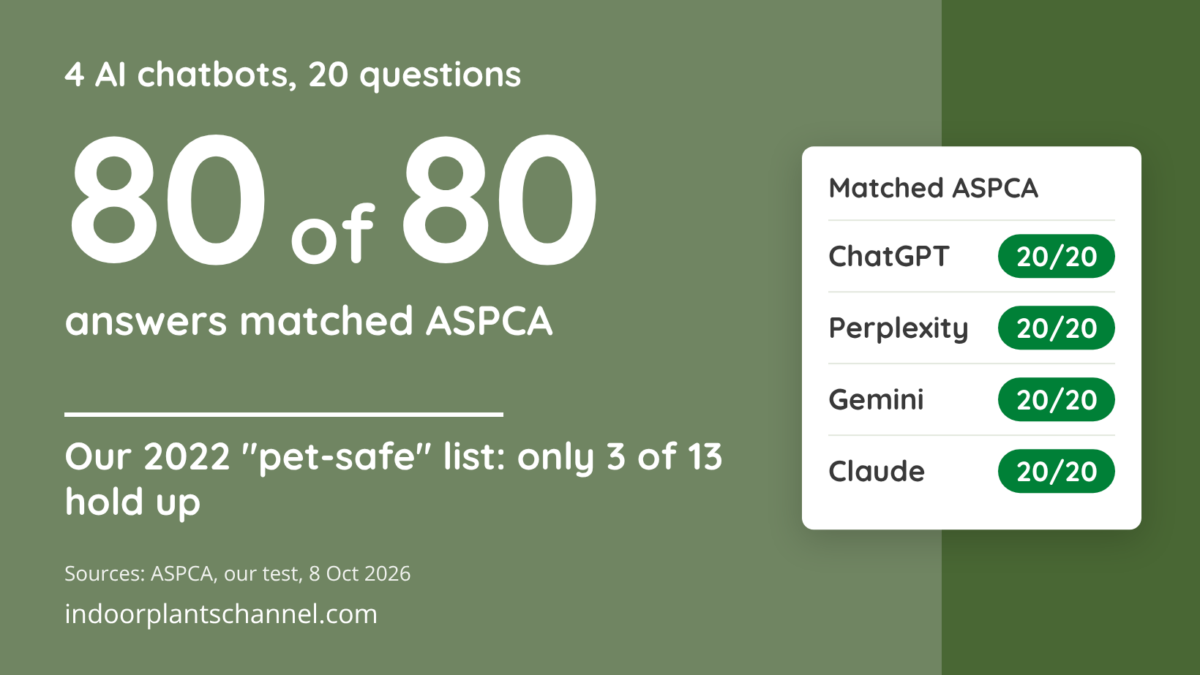
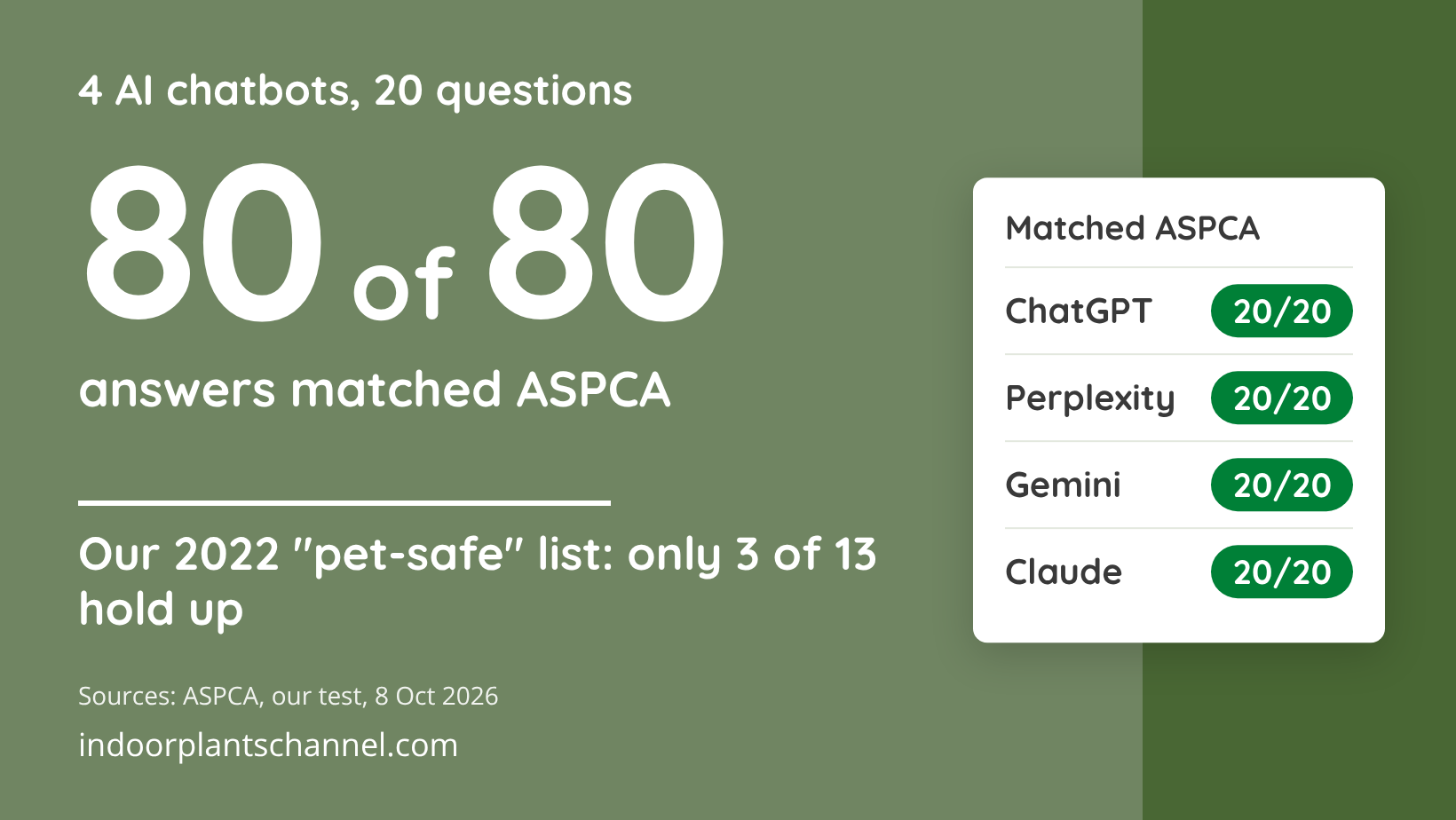
If you’d ask a chatbot before you search, here is how that would have gone. On 8 October 2026 we sent the same 20 questions to ChatGPT, Claude, Gemini and Perplexity, through each API with web search on. That’s 10 common houseplants, each asked for cats and for dogs: pothos, spider plant, snake plant, peace lily, Easter lily, Peruvian lily, Boston fern, aloe vera, parlor palm and money tree.
Each question went in bare, the way you’d type it holding the plant: “Is pothos toxic to cats?” The answer key was the ASPCA entry for each botanical name. 80 calls, $2.80 in logged API cost.
| Engine (model as returned) | Verdict matched ASPCA | Linked any source | Linked aspca.org | Named the genus | Printed ASPCA’s phone number |
|---|---|---|---|---|---|
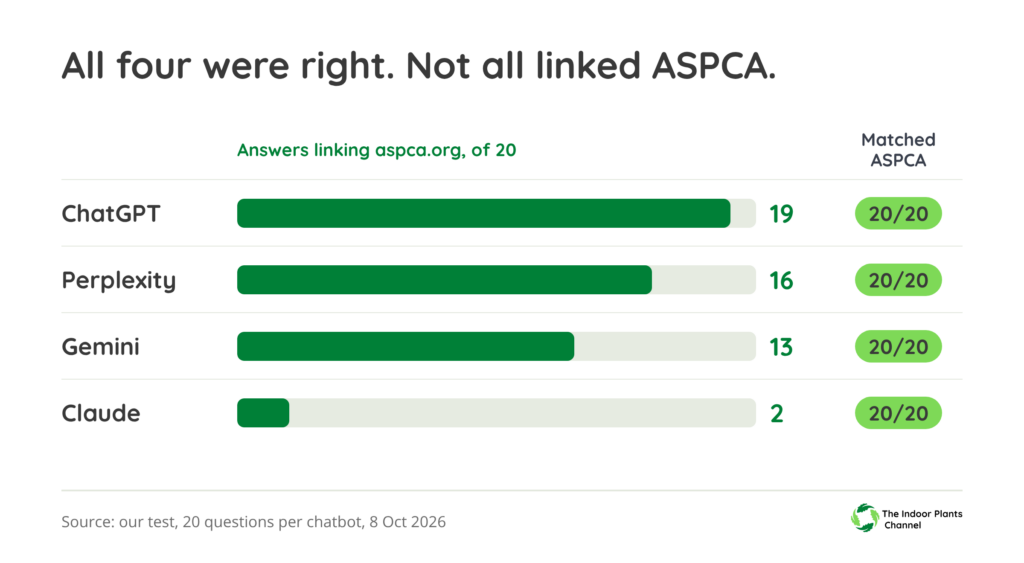
| ChatGPT (gpt-6-sol) | 20 of 20 | 20 | 19 | 11 | 12 |
| Claude (claude-sonnet-5-5) | 20 of 20 | 2 | 2 | 20 | 17 |
| Gemini (gemini-3-flash-preview) | 20 of 20 | 20 | 13 | 18 | 5 |
| Perplexity (sonar) | 20 of 20 | 20 | 16 | 13 | 4 |
What stood out
All 80 verdicts matched ASPCA. On common plants, every chatbot beat our 2022 page by a mile. Four answers, one from each chatbot, softened a correct “non-toxic” to something like “not considered highly toxic.” ChatGPT, Gemini and Perplexity did it on Peruvian lily for cats, Claude on Easter lily for dogs, and the FDA’s note that both can cause mild stomach upset makes that fair.
The real difference was sourcing. Claude named the ASPCA in all 20 answers but linked a source in only 2, both on Peruvian lily, and three times it said the fact was “well-established, so I didn’t need to search for it.” It was right, but you had to take its word. ChatGPT’s 30 citations all went to ASPCA, the FDA or Pet Poison Helpline. Gemini linked the most, not the best: of its 177 citations, 28 were ASPCA, FDA or Pet Poison Helpline pages and 12 were Reddit, Facebook or YouTube.
A few extras crept in. Claude and Gemini both said spider plants are “mildly hallucinogenic” to cats, which isn’t on the ASPCA page. In one answer Gemini said true lilies “can also be toxic to dogs.” That contradicts ASPCA’s plant entries and the FDA, but it matches ASPCA’s own 2022 article, so the chatbot was repeating a disagreement that already exists inside ASPCA.
This was one run on one day, through the API rather than the apps, on easy questions about famous plants. It says nothing about plants that aren’t on the list at all, which is where a confident answer is most likely to be made up.
What a trustworthy plant answer looks like
You can’t tell a right answer from a confident wrong one by reading it. An answer you can act on does four things:
- It gives the botanical name, so you can check it’s the plant on your tag.
- It links the ASPCA entry or another named primary source, such as the FDA or a university vet school like Cornell’s Feline Health Center.
- It tells you when the source was read, because entries change.
- It says so when the source doesn’t cover the plant.
The ZZ plant (Zamioculcas), the fiddle-leaf fig (Ficus lyrata) and Ficus elastica, the rubber plant species, don’t appear anywhere on the ASPCA list. ASPCA says plainly that its list is “not meant to be all-inclusive.” For those plants the honest answer is “ASPCA doesn’t list it, so ask your vet,” not a cheerful yes or no.
You’ll also run into chatbots on nursery, vet clinic and plant society websites. The useful ones are assistants configured to say they don’t know when their own library doesn’t cover the plant, and they point you to your vet or Poison Control instead of guessing.
If your pet ate a plant
- Take the plant away, along with any chewed pieces.
- Photograph the plant and its tag, or bring the plant with you. The FDA asks for exactly this so the vet can tell which lily it is.
- Call your vet, ASPCA Animal Poison Control at (888) 426-4435 (24 hours a day, 365 days a year; a consultation fee may apply) or Pet Poison Helpline at (855) 764-7661 (24/7; $89 per incident, follow-up calls included).
Cats and true lilies: don’t wait for symptoms. The FDA’s timeline runs like this. Early signs show up 0 to 12 hours after eating, signs of kidney damage at about 12 to 24 hours, and kidney failure within 24 to 72 hours. If treatment is delayed by 18 hours or more, the cat will generally have irreversible kidney failure. Cornell adds that even tiny amounts can do it.
Plants and fungi made up 7.5% of the cases ASPCA Poison Control handled in 2025, down from 8.1% in 2024. Save both phone numbers in your contacts now, while nobody is panicking.
FAQ
Is pothos toxic to cats?
Yes. Golden pothos (Epipremnum aureum) is toxic to cats and dogs on the ASPCA list. Its insoluble calcium oxalates cause intense burning and irritation of the mouth, tongue and lips, drooling, vomiting and difficulty swallowing. Keep it out of your cat’s reach, or swap it for a wax plant (Hoya carnosa).
Is a spider plant safe for dogs?
Yes. Spider plant (Chlorophytum comosum) is non-toxic to dogs and cats on the ASPCA list. A dog that eats a lot of it may still vomit, since any plant can upset a stomach, but ASPCA doesn’t expect that to be life-threatening.
Are all lilies dangerous to dogs?
No. ASPCA lists true lilies such as Easter lily as non-toxic to dogs, and the FDA says dogs that eat lilies may get minor stomach upset but no kidney failure. ASPCA’s 2022 article says lilies can be toxic to dogs too, so call your vet. Peace, calla and lily of the valley are toxic to dogs.
Is the ZZ plant on the ASPCA list?
No. On 8 October 2026 the ASPCA list had no entry for the ZZ plant (Zamioculcas), and none for the fiddle-leaf fig or Ficus elastica either. Not listed doesn’t mean safe, because ASPCA says the list isn’t all-inclusive. Treat it as unknown and ask your vet before it goes where a pet can chew it.
My cat licked lily pollen off its fur. Is that serious?
Yes, if it was a true lily or a daylily. The FDA says licking a few pollen grains off the fur while grooming can cause fatal kidney failure in less than 3 days, and that you should immediately call your vet or a pet poison control center. Don’t wait for symptoms. Bring the lily, or a photo of it, so the vet can tell which kind it is.

6 Comments
Leave a Reply

Michelle Wilde is a stay-at-home mom and avid plant lover. Armed with a post-graduate degree in Computer Science (no kidding!), she loves researching plants and landscapes. When she is not caring for her 4 kids, she spends time on her passion for plants. She blogs at www.indoorplantschannel.com, the trusted source for indoor plants.
Learn more
[…] to add a touch of nature to your home without worrying about your pets? Check out these 20 indoor plants that are safe for both cats and […]
[…] you’re looking for the best indoor plants that are also pet-friendly, look no further! In this blog post, we’ll share our top 15 picks that […]
[…] is a natural product, so it is safe to use around plants and […]
[…] of the remains of tiny marine organisms, is a great way to get rid of clover mites naturally. It is safe to use around food and plants, and it is very effective. It is sharp and abrasive and it will kill clover mites by puncturing […]
[…] you have pets in your home and are looking for safe plants, this article lists 27 indoor plants that are safe for […]
[…] So if you’re looking for a way to brighten up your home and your mood, adding some cat-friendly plants is a great […]