

Plant society members get care answers in five places: Extension’s Ask an Expert line, the society’s own expert, journal back issues, care sheets and forums. The volunteers behind them answer carefully, and careful takes time: in 85 houseplant threads we timed on Ask Extension, the free expert Q&A run by US land-grant universities, the median first reply took 25 hours. Below: where each channel works, the questions nobody should guess at, and a checklist for making your care library easier to search.
This is for whoever in your society or garden club ends up answering the email, the Facebook comment and the question at the show bench. We read each channel on its owner’s own site and timed a public sample of real houseplant questions ourselves, all on 8 October 2026.

Five places members ask
1. Ask Extension and the Master Gardener lines
If you’re in the US, you already have an expert line: Ask Extension. It gives “one-to-one expert answers from Cooperative Extension/University staff and volunteers” at land-grant universities across the country. Some of its answer pages tell askers that questions are “usually answered within two business days”, and every answered question goes into a public archive you can filter by state and county.
State programs set their own promises. In Minnesota, a Master Gardener volunteer replies by email “within 48 hours, Monday through Friday”, and the form takes up to 3 photos of 8MB each. Leave a message on the phone line and a volunteer returns your call within 4 days. Penn State has Master Gardeners in 58 Pennsylvania counties trained to answer residents’ questions, and when they can’t diagnose a problem locally they can consult the university’s Plant Pathology Clinic or Entomology Lab. A society volunteer rarely has that escalation path.
What 85 houseplant questions show
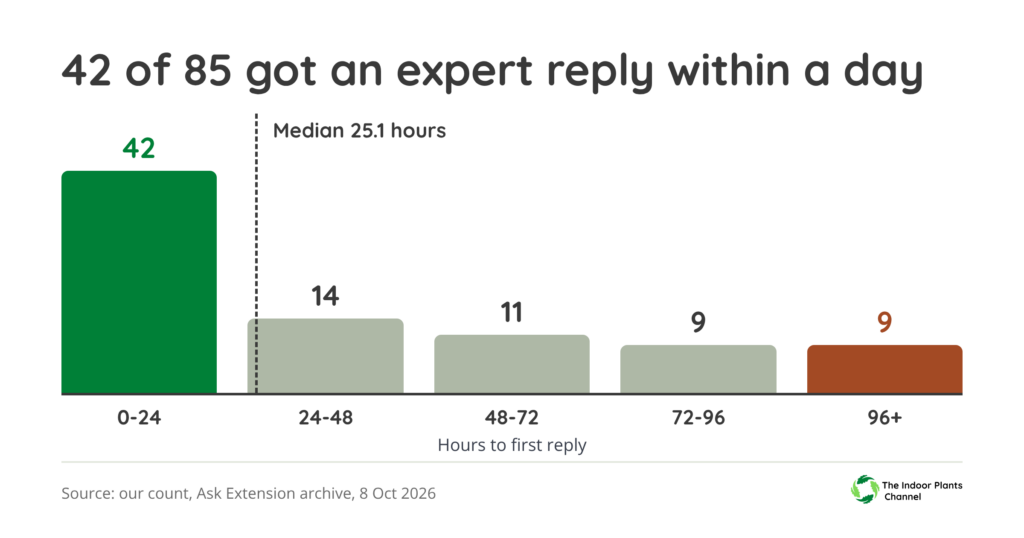
So we counted. On 8 October 2026 we searched the public Ask Extension archive for “houseplant”, which returned 85 answered questions. We read every thread, timed the gap between the question and the first expert reply from the timestamps on the page, and labeled each question’s topic by hand. The questions were asked between 2 December 2025 and 2 October 2026, from 12 states. Maryland (25) and Minnesota (19) supplied the most.
| What we measured (n = 85) | Our count |
|---|---|
| Median time to first expert reply | 25.1 hours |
| First reply within 24 hours | 42 threads |
| First reply after more than 4 days | 9 threads (longest 142 hours) |
| Needed more than one expert reply | 34 threads |
| Answer linked an Extension or .edu source | 69 threads (16 linked no Extension or .edu source) |
| Asker had already used or named a treatment product | 13 threads |
| Asker asked whether the plant was toxic to a cat | 2 threads |
| “Houseplant” hits that were really about outdoor plants or other subjects | 8 threads |

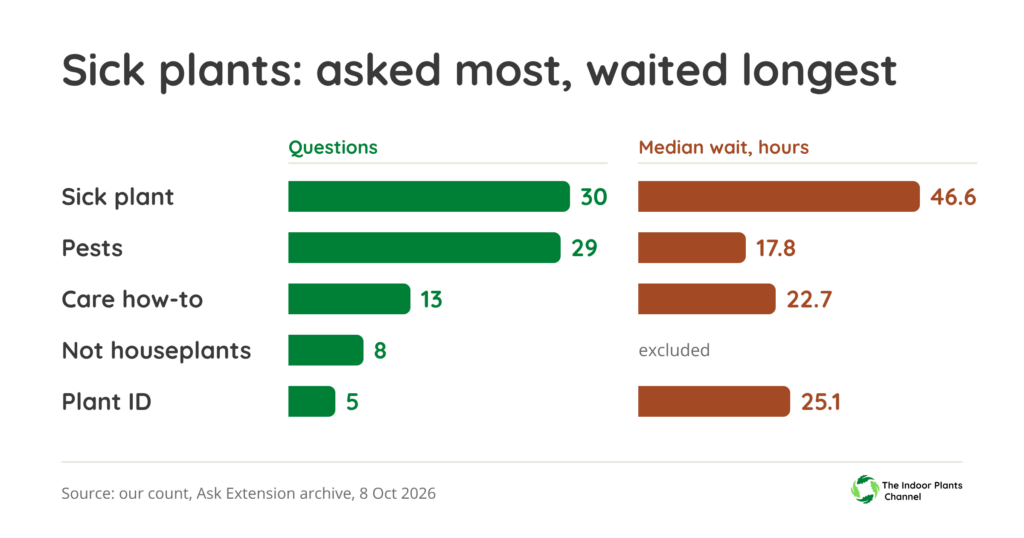
The topic split is where it gets useful for a society. Sick plants made up 30 questions, pests 29, care how-to 13 and plant ID 5. Sick-plant questions also waited longest, a median of 46.6 hours, against 17.8 hours for pests and 22.7 for care how-to. Our guess: naming a bug from a photo is quicker than diagnosing a decline, which often needs a follow-up about watering, light and soil.
Caveats: the archive shows only answered, published questions, the sample is one search term, and calendar hours mean weekends count against the volunteers. Read it as a picture of a well-run volunteer service, not a league table.
2. The society’s own expert
The best example we found is the American Orchid Society’s Ask the Orchid Doctor. Each month Dr. McHatton, the society’s resident orchid doctor, runs a live session, and beforehand he “reviews member-submitted questions and photos”. Every webinar is recorded and made public “complete with an index of topics and timestamps”. Those timestamps turn one expert’s hour into something a member can search long after the session ends.
Smaller societies do it by correspondence or by calendar. The American Begonia Society offers members a Horticultural Correspondent “to answer your growing questions”, and International Aroid Society members can join Aroid Hour, “live, members-only calls with aroid experts”, with the chance to ask questions directly.
3. Journal back issues
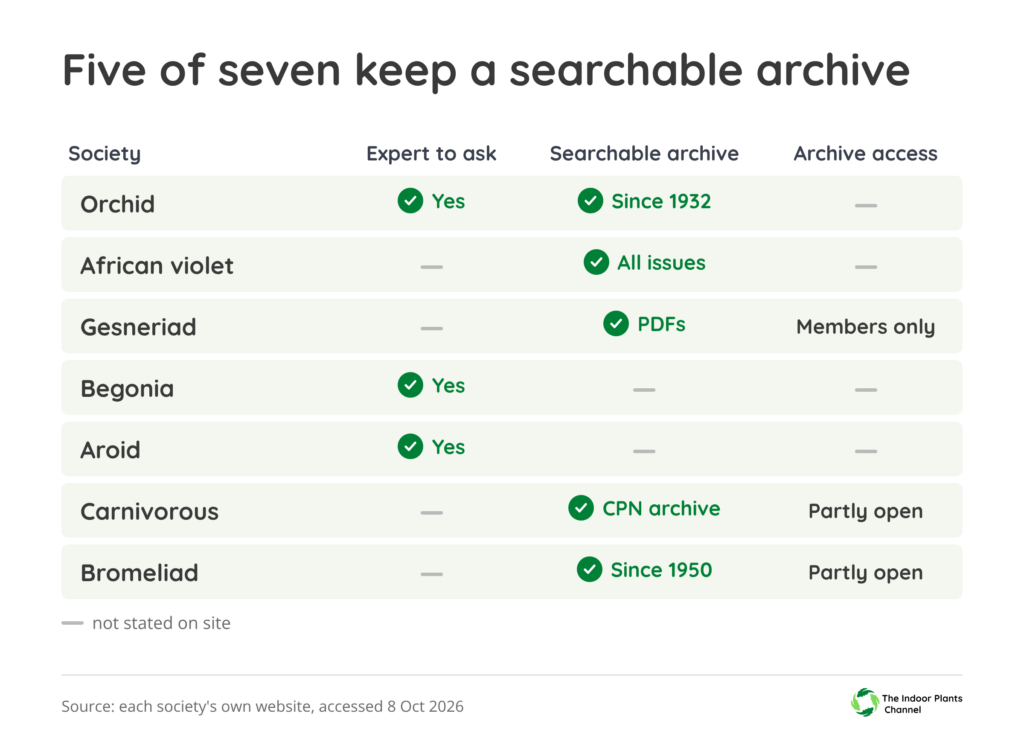
A journal is decades of answered questions, and societies split on who gets to read them. Orchids magazine has been published since 1932, and the AOS lets you search over 10,000 articles; AVSA puts all past issues of African Violet Magazine in its article database. The Gesneriad Society keeps back issues of Gesneriads for members only, as searchable PDFs, while Bromeliad Society International lets anyone word-search its journal back to 1950 and keeps the last 10 volumes behind a member login.
The ICPS takes a third line with Carnivorous Plant Newsletter: scientific and taxonomic articles are open access from the issue date, other articles are members-only for six months, and the archive is also kept at the Biodiversity Heritage Library. If you’re setting rules for your own society, that split is the one to copy. The science stays public, which is how new growers find you, and members get six months’ head start on everything else.
4. Care sheets and guides
The AOS has an orchid troubleshooter you can search by keyword, which is about as close as any society gets to “type the symptom, get the page”. International Aroid Society members get an eight-guide pack that includes a Common Health Issues guide for “fungal, root, and environmental problems”. The ICPS publishes free growing guides by genus, from Cephalotus to Sarracenia, and the Gesneriad Society hosts the Gesneriad Reference Web, which it calls “a living wiki site”.
5. Forums and groups
Then there’s the Facebook group. The ICPS home page invites it outright, “Have questions? Ask! We don’t bite, but our plants do.”, and links its forum group; the IAS gives members a members-only Discord server. Groups are fast, but answers scroll away and nobody owns them.
“Not stated” below means the page we read didn’t say. For dues and how to join, see our directory of plant societies worth joining.
| Society | Expert members can ask | Searchable back issues | Who can read them | Care guides |
|---|---|---|---|---|
| American Orchid Society | Ask the Orchid Doctor, monthly | Orchids since 1932, 10,000+ articles | Orchid Doctor recordings are public | Keyword troubleshooter |
| African Violet Society of America | Not stated | All past magazine issues, article index | Not stated | Not stated |
| The Gesneriad Society | Not stated | Gesneriads, searchable PDFs | Members only | Gesneriad Reference Web (wiki) |
| American Begonia Society | Horticultural Correspondent | Not stated | Not stated | The Begonian covers pests and disease |
| International Aroid Society | Aroid Hour, live members-only calls with experts | Not stated | Journal goes to members | 8-guide pack for members |
| International Carnivorous Plant Society | No (open Facebook forum) | CPN archive, also at BHL | Science open at once; rest members-only for six months | Free guides by genus |
| Bromeliad Society International | Not stated | Journal back to 1950 | Last 10 volumes members only | Not stated |

The questions that should never get a guessed answer
Most care questions are forgiving: bad watering advice costs you a leaf. A handful are not, and the good volunteers in our sample treated them differently.
“Is it safe for my cat?”
Two of our 85 askers wanted to know whether a plant was toxic to their cat. In one thread a New Hampshire volunteer named the plant as Scindapsus pictus, said “yes it is toxic to dogs and cats” and pointed to the ASPCA list, which does list satin pothos as toxic (insoluble calcium oxalates). In the other, an Oregon volunteer helped with the ID but “can’t give advice about the pet-safety”. The ASPCA lists both candidate plants in that thread, Pilea involucrata and Peperomia caperata, as non-toxic to dogs and cats.
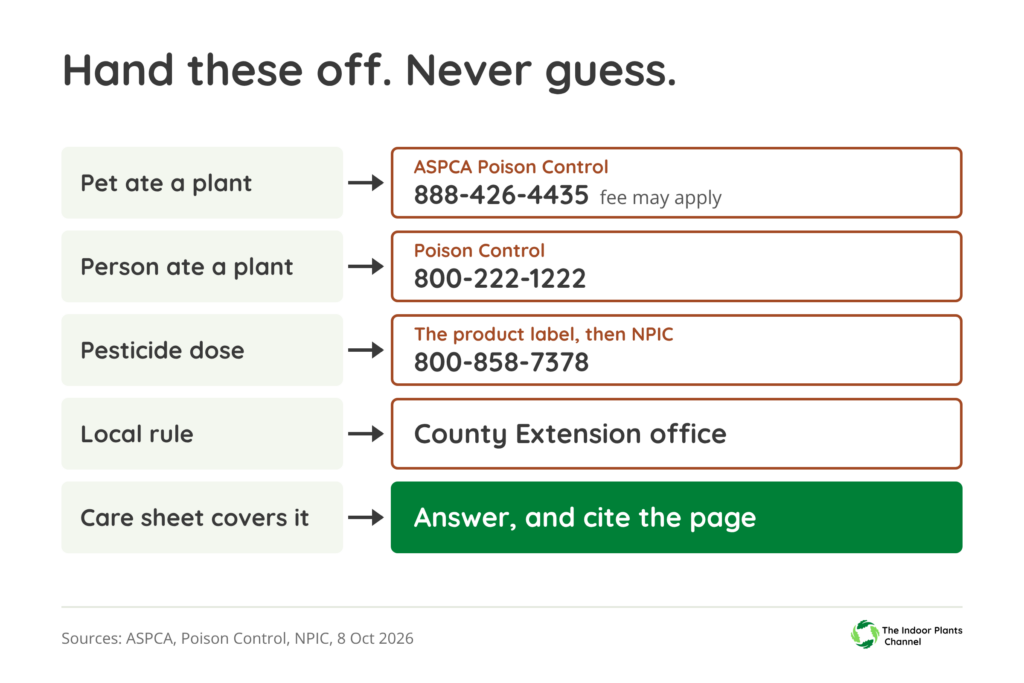
Both answers were responsible, and the first is the one to copy: give the botanical name and link the ASPCA page. The ASPCA itself says its list “is not meant to be all-inclusive” and asks you to check the plant’s name. And the name is the weak point. Master Gardeners in Buncombe County, North Carolina, warn that AI “often fails to accurately identify plants”, which matters most when you’re trying to avoid toxic ones. If a pet has already eaten something, the answer is a phone call: ASPCA Animal Poison Control at 888-426-4435, 24 hours a day, 365 days a year (a consultation fee may apply). For a person, call Poison Control at 800-222-1222, which is free.
Pesticides and doses
Thirteen of our 85 askers had already used or named a product, from neem to a systemic insecticide, before they asked. That’s the moment a guessed dose does real harm. Every pesticide label carries a line saying misuse violates federal law; the EPA’s own shorthand is “the label is the law”. A Michigan volunteer told an asker the same thing in almost those words. When a Minnesota asker described a systemic insecticide, the volunteer asked for “a picture of the product label” first, because different neonicotinoids last different lengths of time in cuttings.
Chatbots have the same trouble with labels. In a 2026 GROW weed-management test, the three general chatbots scored 19% to 33% on herbicide label questions; ExtensionBot, the fourth, managed 43%. As GROW’s Flessner put it, many versions of a label float around online, but only the one on the jug matters. For questions about a product, the hand-off is the label and the National Pesticide Information Center, 800-858-7378. Before any of that, Penn State’s Master Gardeners look for the fix “with the least toxicity”, and note that a plant ailment can often be traced to watering, siting or soil and fixed without pesticides at all.
Advice that depends on where you live
Minnesota’s form says its “answers … are specific to Minnesota”, and some of the Ask Extension answers we read end by pointing you to your local county Extension office. In one thread a Minnesota volunteer couldn’t find a state publication on an office houseplant and used University of Illinois care guides instead, and said so. Buncombe County’s Master Gardeners found an AI garden site that cited Extension yet “only showed information from Minnesota” on native plants for North Carolina readers.
When the expert isn’t sure
Our favorite answers in the archive admit doubt. One volunteer wrote “I am not 100% confident of my identification of your plant”. Another told an asker “I have confidence in about 70% of your questions” and offered to send them to MSU faculty. That’s the bar for any answer, from a volunteer or a bot.
Stale or conflicting pages
Careful sites drift too: on the same day, the Gesneriad Society’s home page said the family has over 3,400 species and its FAQ page said over 3,200. That one is harmless. The riskier kind is advice that outlives its product: in a 2025 GROW test, ExtensionBot recommended a herbicide use whose products were no longer available. A care sheet that still names a discontinued spray fails the same way.

Making a care library searchable
Between the journal index, the troubleshooter, the guide pack and the recorded webinars, the societies above already hold most of the answers; the hard part for a member is finding the right page from a plain question. Keyword search alone gets noisy: 8 of our 85 “houseplant” hits were about oaks, peonies, maples and the like.
Extension already runs one answer tool on its own library. ExtensionBot “constrains its responses to curated content” from Extension institutions and Ask Extension, and grounds every answer “in cited sources that users can verify”. An institution can set it to favor its own content, and its data platform also shows when each dataset was last crawled, which is exactly the question to ask of a care sheet. A Mississippi State Extension feature describes the unglamorous first step as “organizing, cataloging and digitizing the data”, and ExtensionBot’s project manager, Debbie Brown, warns that without well-organized data “it is very hard to assume your AI is giving an answer that is trustworthy.”
One horticulture association already runs an assistant on its own library. In May 2025 AmericanHort, the national horticultural association, launched Sage, which draws on AmericanHort’s own resources, “does not pull from public sources” and is “not meant to replace human interaction”. After every answer it asks for a thumbs-up or thumbs-down.
Citing sources did not make ExtensionBot the most accurate bot in GROW’s 2026 test (ChatGPT scored 60%, ExtensionBot 54%), but it was the only one that “consistently linked to the sources of its information”, which is what lets a member check the answer instead of trusting it.
For a society, that means loading your care sheets, FAQ and journal index into an assistant that answers only from them and names its page. Professional associations face the same job with their standards and reports, and this walkthrough of how associations make their standards and reports searchable maps cleanly onto a care-sheet library. Whatever tool you use, write one rule into it before anything else: it names its source, and on toxicity, pesticide doses and local regulations it refuses and hands off instead of guessing. Will Woodham, NC State’s digital content specialist, put it best on the Buncombe Master Gardeners’ site: “Don’t trust and definitely verify!”
A volunteer-sized setup checklist
You don’t need a committee. One owner per item is enough to start.
- ☐ Gather what you already have: care sheets, the FAQ, the journal article index and any culture guides or troubleshooter pages.
- ☐ Give every care sheet an owner and a review date, and fix the ones that contradict each other before anything else.
- ☐ Keep diagnosis human. Photo diagnosis goes to your expert or correspondent, and hard cases go to a university lab through Extension.
- ☐ Print the hand-offs and tape them by the show bench: ASPCA 888-426-4435 for pets, Poison Control 800-222-1222 for people, the product label and NPIC 800-858-7378 for pesticides, and your county Extension office for local rules.
- ☐ Ask for feedback on every answer and read the question log once a month; it tells you which care sheet to write next.
- ☐ Say how fast a human replies. Ask Extension’s answer pages say two business days; our sample’s median was about a day.
Quick answers
Does any plant society use an AI assistant for members?
None of the seven we read says so on its own site. The verified examples are Extension’s ExtensionBot and AmericanHort’s Sage, launched in May 2025.
How fast does Ask Extension answer?
Median 25.1 hours to a first reply in our 85 houseplant threads; 9 took more than four days.
Can a chatbot tell me whether a plant is safe for my cat?
Use it for a botanical name, then check that name on the ASPCA plant list. If your pet has eaten a plant, call 888-426-4435.
Is a society’s journal archive worth joining for?
If you grow one genus seriously, often yes: Gesneriad and BSI back issues are partly or wholly members-only. Compare dues in our plant society directory.
What were the off-topic “houseplant” hits about?
Oaks, peonies, maples, a butterfly bush and the like: 8 of 85 hits, which is why plain keyword search isn’t enough.